

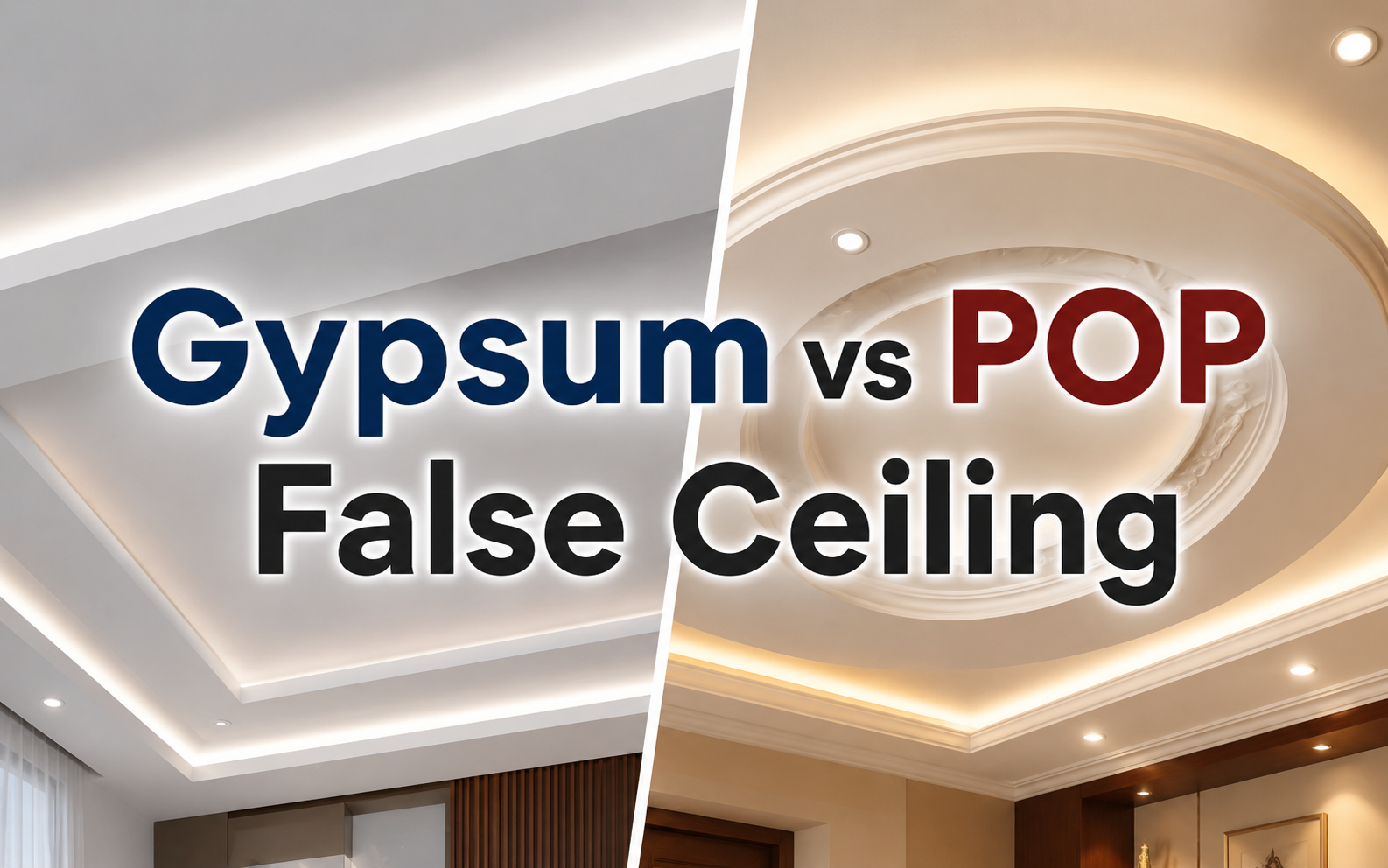
Gypsum vs POP False Ceiling – Which is Better for Your Home?
Let's be honest. Choosing a false ceiling for your home isn't just about covering up those ugly wires and pipes anymore. It's about aesthetics, durability, maintenance, and yes, your sanity during installation.
If you've been scrolling through Pinterest or talking to contractors, you've definitely come across two heavyweight contenders: Gypsum and POP, which stands for Plaster of Paris. Both have loyal fan clubs. But which one actually deserves a spot in your home?
I have seen both materials up close. Installed, repaired, and even replaced them over the years. So let's break this down like real people, not textbook definitions.
First Things First. What Exactly Are We Talking About?
POP, or Plaster of Paris, is that fine white powder you mix with water to create a paste. It hardens quickly into a smooth, solid surface. Your grandfather probably had POP ceilings with those intricate floral patterns that looked like wedding cakes.
Gypsum, on the other hand, comes as ready made boards. Rigid, flat panels with a paper-like covering on both sides. You don't mix anything on site. You just cut, screw, and fix it to a metal frame.
So already, you see the difference. One is wet, messy, and handmade. The other is dry, clean, and factory made.
Let's Talk About the Real Stuff. Which One Wins Where?
1. Installation Time, Because Nobody Likes Construction Dust
POP takes time. And I mean real time. First, your ceiling is built with wooden or metal battens. Then comes the labor intensive process of applying layer after layer of POP paste, smoothing it, letting it dry, sanding it, and repeating. On average, a POP ceiling takes 4 to 7 days for a medium sized room, and that is only if the weather cooperates. Humidity slows drying.
Gypsum is like assembling IKEA furniture, but easier. The boards are screwed onto a metal framework, joints are taped and puttied, and boom, you are done in 1 to 2 days. Less mess, less noise, less headache.
Winner: Gypsum, by a mile.
2. Finish and Smoothness, That Perfect Look Factor
If you want a glass smooth, flawless finish that looks like it was painted by angels, POP is the king. Because it is applied wet, it fills every tiny gap, corner, and irregularity of your original ceiling. After sanding, it becomes so smooth that your painter will actually thank you.
Gypsum gives a good finish too, do not get me wrong. But because it is made of boards joined together, you might see hairline cracks at the joints over time if not installed perfectly. That said, with good workmanship, most people won't even notice.
Winner: POP, purely for that museum grade smoothness.
3. Flexibility in Design. Want Curves? Patterns? Drama?
Here is where POP shines like a diamond. Since it is applied as a paste, skilled artisans can mold it into anything. Curves, arches, domes, floral motifs, even your family crest if you want. If your dream ceiling looks like something out of a Mughal palace or a European cathedral, POP is your material.
Gypsum is stiff. You can get pre-curved boards, but they are expensive and limited. You can do simple geometric designs like step patterns, coffers, and recessed trays, but intricate, organic curves are not really possible.
Winner: POP, hands down for customization.
4. Durability and Strength. Will It Survive Life?
Gypsum boards are surprisingly strong. They don't crack easily with normal wear and tear. They are also moisture resistant if you buy the green or blue boards, and fire resistant, which is a huge safety plus.
POP, on the other hand, is brittle. A slight settlement of your building, a small earthquake tremor, or even accidental pressure while changing a bulb can cause a crack. Now you have a spiderweb on your ceiling. Also, POP is not moisture friendly. In humid areas or if there is a leak from the floor above, it can sag, stain, or even crumble.
Winner: Gypsum, for long term peace of mind.
5. Maintenance and Repairs, Because Life Happens
Here is a scenario nobody talks about. Five years later, you decide to install a new light fixture or run an extra wire for a projector. With a gypsum ceiling, you just unscrew a board, do your work, and screw it back. Patch the joint and you are done.
With POP, you are calling a mason. They will have to chip away, reapply, let it dry, sand it, repaint the entire section, and you will still see a patch if the paint doesn't match perfectly. Repairing POP is messy, expensive, and time consuming.
Winner: Gypsum. Future you will thank you.
6. Cost. What Does Your Wallet Say?
This is a tricky one. POP material itself is cheaper than gypsum boards. But, and this is a big but, POP labor cost is significantly higher because it demands skilled artisans and more man hours. Add the cost of wooden battens, primer, and paint, and you might end up spending more than a basic gypsum ceiling.
Gypsum boards cost more per square foot, but installation is faster and requires less skilled labor. Overall, for a standard flat ceiling, gypsum usually works out 20 to 30 percent cheaper in total project cost.
But for heavily customized POP designs, the sky is the limit, literally your budget.
Winner: Gypsum for standard designs. POP if you are going all out with art.
7. Weight. What Is Hanging Over Your Head?
POP is heavy, especially if it is thick. That adds load to your structural ceiling, which matters if your building is older or has slab issues.
Gypsum boards are lightweight, about half the weight of an equivalent POP ceiling. That is easier on your structure and safer in the long run.
Winner: Gypsum.
The Final Verdict. So Which One Should You Choose?
Let's make this brutally simple.
If you want quick installation with zero mess, choose Gypsum.
If you want intricate curves and custom designs, choose POP.
If you want long term crack free ceiling, choose Gypsum.
If you want that ultra smooth painted finish, choose POP.
If you want easy access for future electrical work, choose Gypsum.
If you want an affordable standard ceiling, choose Gypsum.
If you want a luxury, artistic statement piece, choose POP.
My Personal Take, From Real Experience
I have recommended gypsum to 8 out of 10 homeowners in the last few years. Not because POP is bad, but because most homes today don't need those heavy ornamental designs anymore. People want clean, minimalist, modern spaces with recessed lights and simple stepped ceilings. Gypsum does that beautifully, quickly, and affordably.
But if you are someone who loves old world charm, or you are designing a luxury villa, a banquet hall, or a traditional themed living room, POP is absolutely worth the time, money, and patience. Just be ready for a longer process and more maintenance down the line.
One Last Tip Before You Decide
Don't just ask your contractor "Gypsum or POP?" Ask them these questions instead.
Show me your previous work with both.
What is the exact timeline and final cost?
What happens if there is a leak or crack later?
A good contractor will give you honest answers. A bad one will just push whatever gives them higher profit margins.
So, which is better for your home?
It depends on your budget, design preference, and patience. For 90 percent of modern homes, gypsum wins. For the 10 percent that crave art and character, POP is timeless.
Choose wisely, because your ceiling isn't something you change every year. It is the fifth wall of your room. Make it count.
Have you installed either of these in your home? I would love to hear your experience. Drop a comment or reach out. Let's learn from each other.
Let me know if you need any other tweaks, like adding more bullet points, shortening it, or making it more SEO friendly with keywords.